Mission-focused. Intelligent. Built for fast, efficient work. A coordinated team
combines specialist aircraft, energy control and shared mission intelligence to
carry the customer’s objective forward.
Powered by the SOFOS Industry Operating System (SIOS). From close inspection to
broad-area coverage, the original three mission aircraft are complemented by SD4
specialist energy support.
Meet SkySharks in the teaser, then explore the full film: specialist aircraft, shared
mission intelligence and the support that carries the mission forward.
One Shark performs the task. A qualified teammate prepares to take over. SIOS keeps the
mission context moving, while Home Safe manages the outgoing aircraft’s recovery.
No routine customer intervention is intended during an authorised handover. GMCC
supervision and exception escalation remain part of the operating model.
Interactive mission demonstration
Illustrative sequence · no live aircraft connection or measured performance
A Active / outgoingB Compatible reliefC Specialist support
Ready to demonstrate
A mission shared by a team.
Choose a mission and event, then start the demonstration.
Task statusShark A ready
Customer actionAuthorise mission
Illustrative mission progress: 0%
SHARK A / OUTGOINGReady
Energy state: ready
SHARK B / COMPATIBLE RELIEFStandby
Energy state: ready
SHARK C / SPECIALIST SUPPORTSupport readySeparate role. Not an automatic substitute.
A replacement must be flight-ready, payload-compatible and authorised. Sudden failure
may leave a coverage gap. A fleet-wide event, loss of common services or absence of a
qualified reserve can stop the mission. Fixed-wing launch/recovery automation is not
yet qualified; this demonstration assumes a deployable replacement.
Shared mission context
Completed work, remaining tasks, operating boundaries and data requirements transfer
with the assignment.
Qualified relief
Handover depends on capability and readiness. A different aircraft type can support
a team without being an interchangeable replacement.
One accountable service
SIOS coordinates the team, Home Safe qualifies recovery and GMCC supports
supervision and exceptions.
03 — Home Safe electromagnetic survivability
Survive the event. Qualify the way home.
SKYSHARKS™ HOME SAFE
Layered airframe protection addresses the disturbance. The Survivability Energy
Booster supports essential power. Protected Home Safe recovery uses the SDBB,
mission breadcrumbs and a qualified corridor to establish the safest achievable next
step.
Beyond conventional return-to-home
A recovery instruction is useful only if the aircraft still has a viable power,
control and navigation path.
Home Safe begins before an event, as the aircraft records protected mission
breadcrumbs and evaluates its return options. Shielding, filtered penetrations and
transient suppression form the immediate hardware boundary. The
Survivability Energy Booster (SEB) supports a protected power
bridge and recovery boot path. The SDBB then reconstructs trustworthy state and
requalifies the Qualified Return Corridor (QRC), selecting an
authorised result: continue, limp home, reverse corridor, divert, hold or controlled
landing.
CONTAINRESTOREQUALIFYRECOVER
The Home Safe intelligence sequence
A way home is prepared throughout the mission.
Mission Breadcrumbs, the Predictive Mission Ephemeris and the Qualified Return
Corridor work together before, during and after a disturbance.
01 / PREPARE
Breadcrumbs travel with the mission.
Versioned route checkpoints preserve the aircraft's observed journey, energy
state, location confidence and relevant hazards in protected mission memory.
02 / ANTICIPATE
Keep a return corridor ready.
The Predictive Mission Ephemeris evaluates forward hazards while the Qualified
Return Corridor maintains feasible return and alternative refuge options.
03 / SURVIVE
Recover essential power and state.
Layered hardware protection and the Survivability Energy Booster support essential
loads and a protected Home Safe boot path separate from ordinary mission
applications.
04 / CONTINUE
Take the safest qualified next step.
Surviving capability and current route conditions determine whether to continue,
follow a requalified corridor, divert, land or call for a mission teammate.
Collision avoidance and return planning share the same time-indexed mission
picture.
Engineering boundary. The SEB is derived from a demonstrated pilot
power-control platform; that does not constitute EMP qualification. Aircraft-specific
packaging, electromagnetic exposure limits and integrated recovery performance remain
subject to design, testing and configuration release. No universal EMP immunity or
guaranteed return is claimed.
04 — SOFOS Device Black Box
The qualified device edge
Mission intelligence that stays with the aircraft.
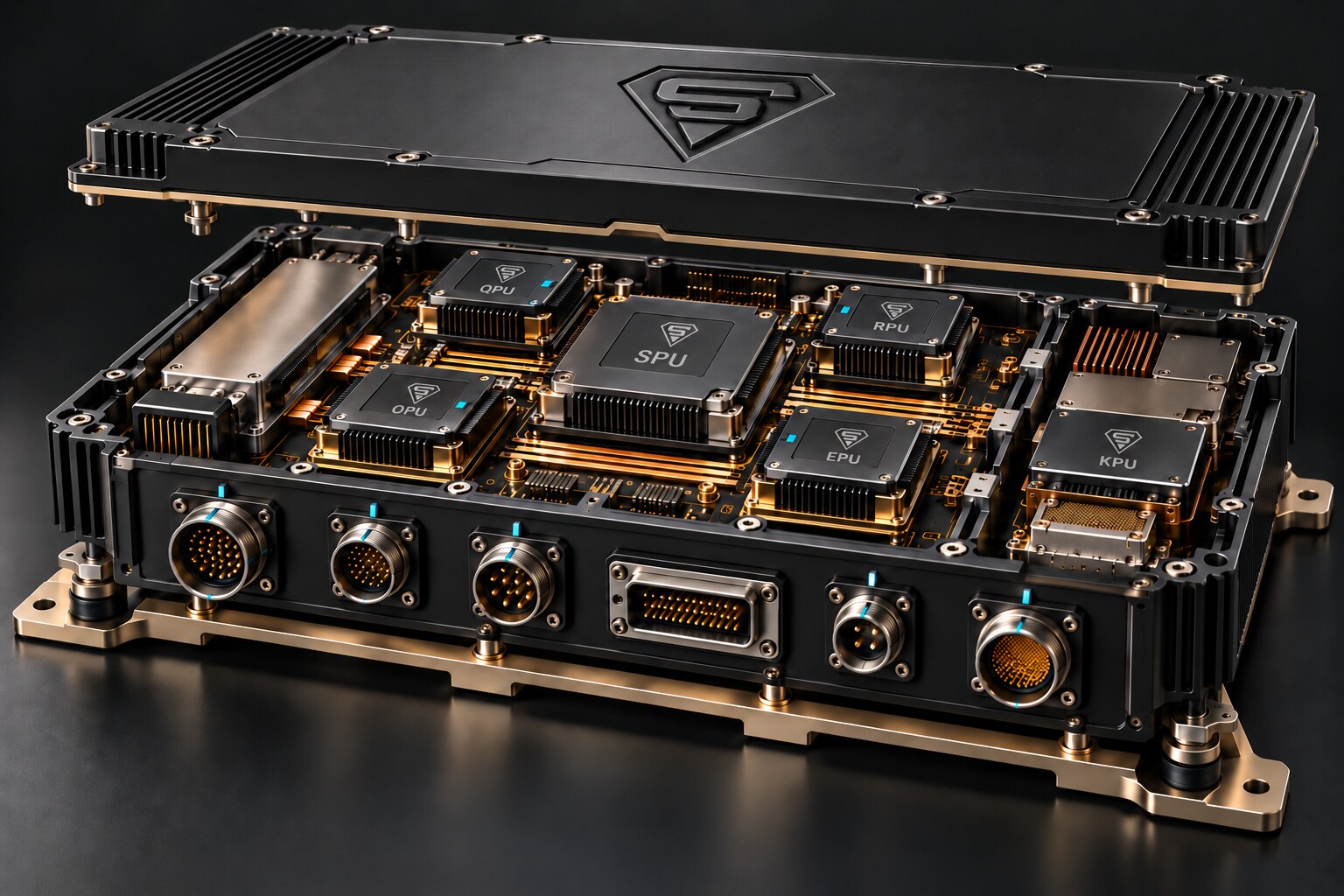
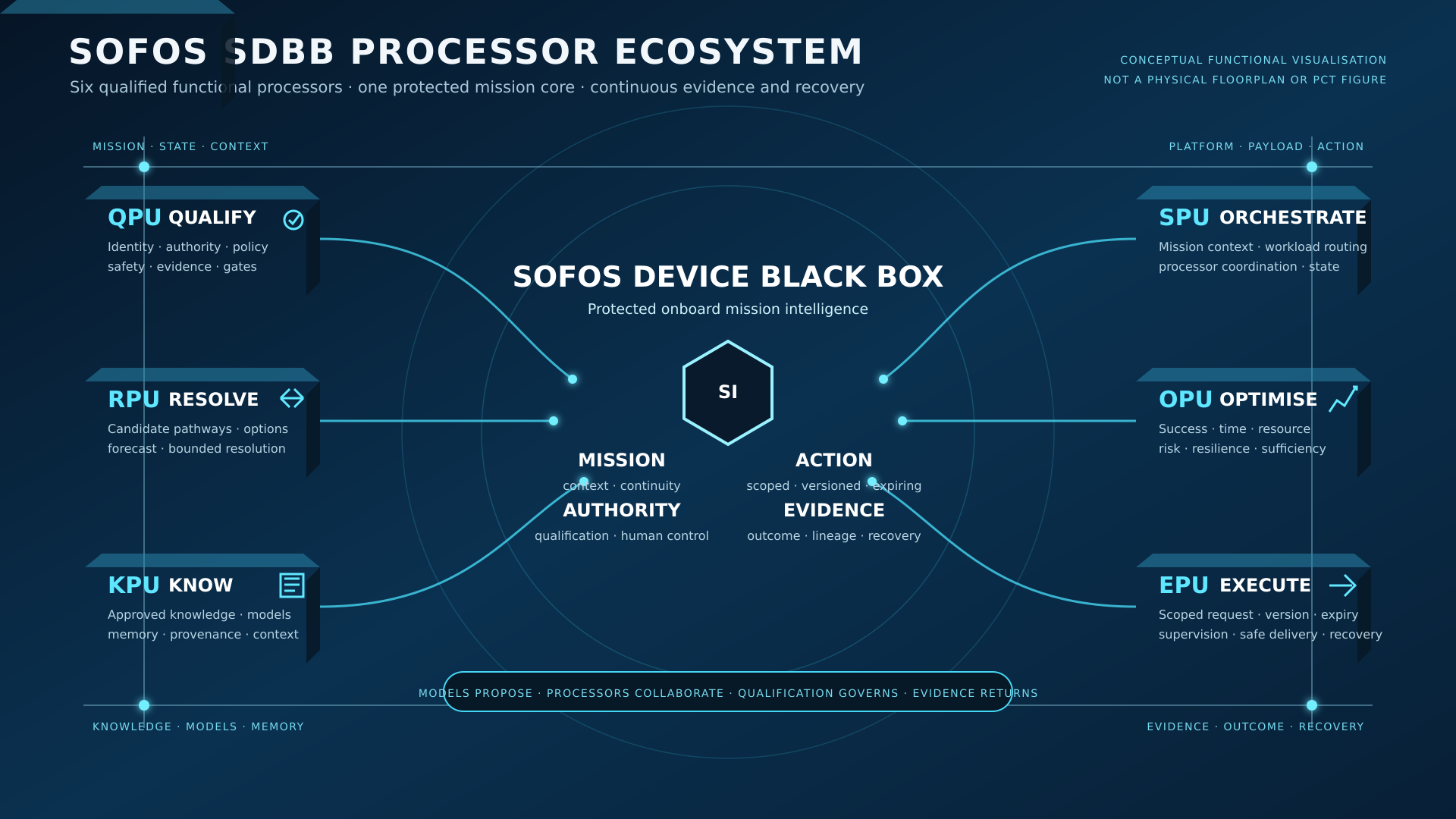
The SDBB is the protected onboard intelligence, qualification and evidence component
proposed for each SkyShark™. It retains bounded mission context and coordinates six
functional processor roles at the device edge.
Retains the admitted mission state, target, constraints, authority and recovery
envelope when a remote service or communications path is unavailable.
Qualified processing
Separates mission, qualification, resolution, optimisation, execution and
knowledge functions so that a fast answer does not bypass mandatory gates.
Local models and memory
Supports bounded onboard SLM, task-model and memory resources allocated to the
relevant processor role and released mission package.
Device evidence
Records source, state, confidence, decision, authority, action and outcome for
assurance, reconstruction and lifecycle return.
SDBB imagery and processor allocations describe the development architecture. Silicon
implementation, performance, environmental qualification and aircraft integration
remain subject to engineering release.
05 — The category
Mission Teams. Continuity by design.
Configure a team around the result. SIOS is designed to retain mission progress,
qualify an available replacement and coordinate a handover while the outgoing Shark
follows its recovery plan.
01
Built around the mission
Three specialist mission aircraft retain their distinct operating profiles. SD4
joins the family as a dedicated utility and aerial replenishment aircraft, alongside
configurable payload kits.
02
Energy has a mission role
Structural photovoltaic skin and PowerFabric / Energy Booster are designed to
coordinate energy sources, payload priorities and recovery reserves. The objective
is useful mission time, not just time aloft.
03
Intelligence travels with the aircraft
The SOFOS Industry Operating System (SIOS) and SOFOS bring mission orchestration and
specialist intelligence into the system through the six functional processor roles
of the SDBB architecture.
04
Connected to mission support
The Global Monitoring and Control Centre (GMCC) provides the proposed framework for
supervision, configuration records, service continuity and customer deliverables.
05
Recovery belongs in the mission
SIOS Home Safe places recovery decisions inside the operating architecture. Return,
divert or land depends on the authorised plan, available energy and surviving flight
systems.
06 — Product portfolio / Three drones
The shape follows the job.
D-LW01 / Long-wing
Extend the mission.
Broad-area observation and corridor coverage, with the photovoltaic upper-wing
architecture.
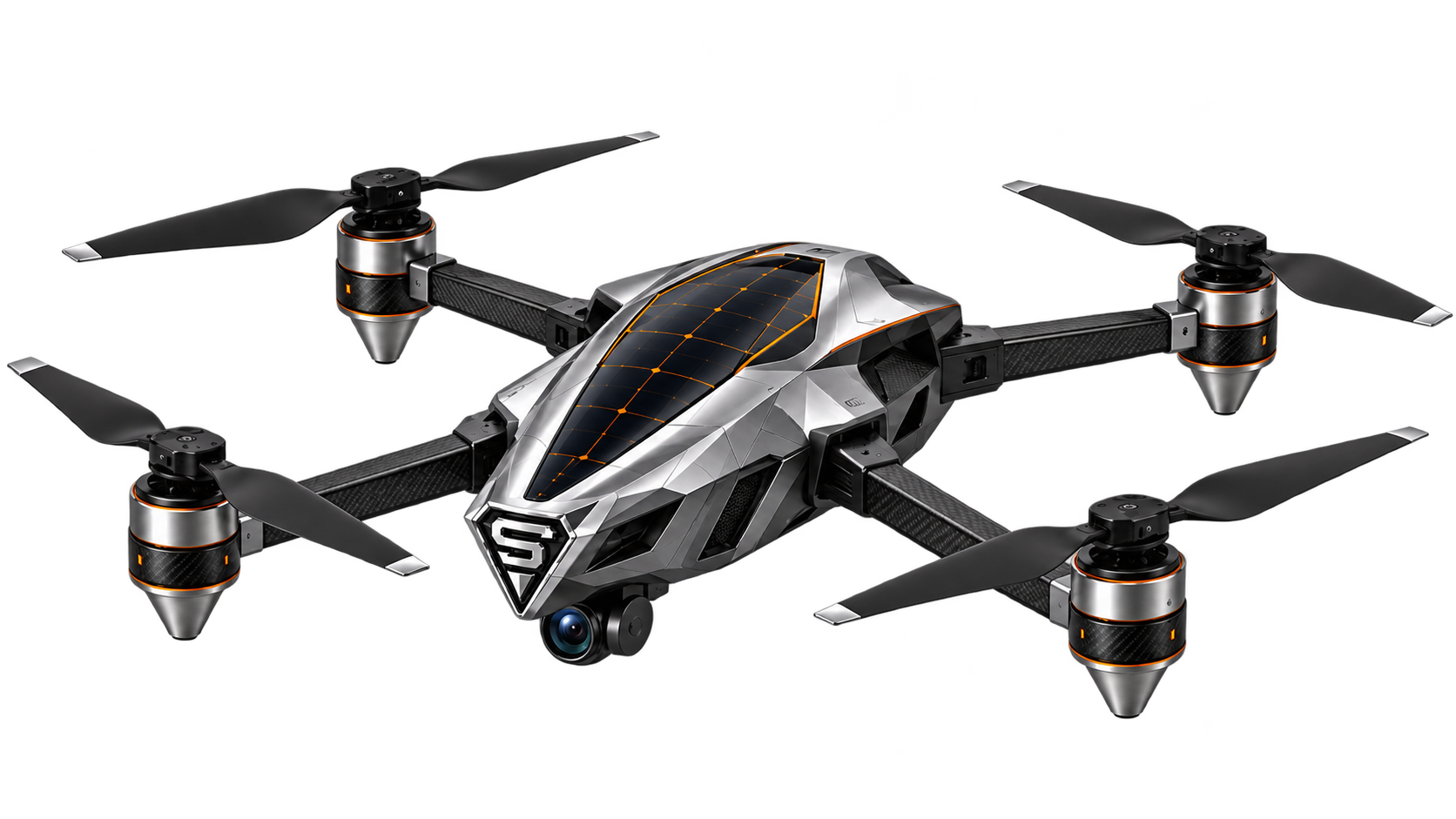
A long-wing electric pusher platform for broad-area and corridor missions. The
photovoltaic upper-wing architecture and mission payload framework support the
programme’s long-endurance objective.
Endurance, range, payload capacity and environmental ratings remain
configuration-specific and unmeasured.
07 — Mission profiles
Start with the outcome.
Explore an illustrative configuration for your application. Each aircraft/kit
combination follows its own qualification and operating-authority path.
Illustrative mission configuration
Infrastructure inspection
Aircraft
D-MR01 for close inspection; D-LW01 for corridors
Payload
D-KIT01 / EO and thermal inspection
Intelligence
Asset-linked observations, inspection workflow and energy-aware recovery planning
Deliverable
Georeferenced EO/thermal records and an asset-linked inspection report
Service
Optional SIOS subscription, analytics and GMCC managed mission support
Host compatibility, measurement calibration and operating permissions require
configuration-specific release.
08 — One Mission Fabric
Different aircraft. One qualified mission.
Aircraft, payload, device intelligence, energy and mission support operate as one
coordinated fabric. Each component keeps its specialist role while contributing to a
common target, authority and evidence record.
Energy joins the mission fabric.SD4 / ARS provides a specialist energy-service pathway alongside existing D-LW01,
D-FW01 and D-MR01 mission roles.Explore energy support →
09 — SOFOS Energy Architecture
Energy is a mission capability.
SkySharks connects photovoltaic capture, battery storage, PowerFabric energy
management, the Survivability Energy Booster and qualified aerial replenishment into
one mission-aware energy strategy.
Energy capture, transfer efficiency, operational endurance and exposure tolerance
depend on aircraft configuration and engineering verification. Magnetic docking is the
alignment interface; electrical energy passes through a separately protected
conductive or inductive transfer path. Directed optical energy transfer is a research
option with independent laser-safety and operating requirements.
SOFOSDRONES
10 — SD4 / AERIAL RECHARGING STATION
Specialist Utility Drone
Energy support aircraft for qualified aerial replenishment and mission utility roles.
SKYSHARKS / SD4 / SUD
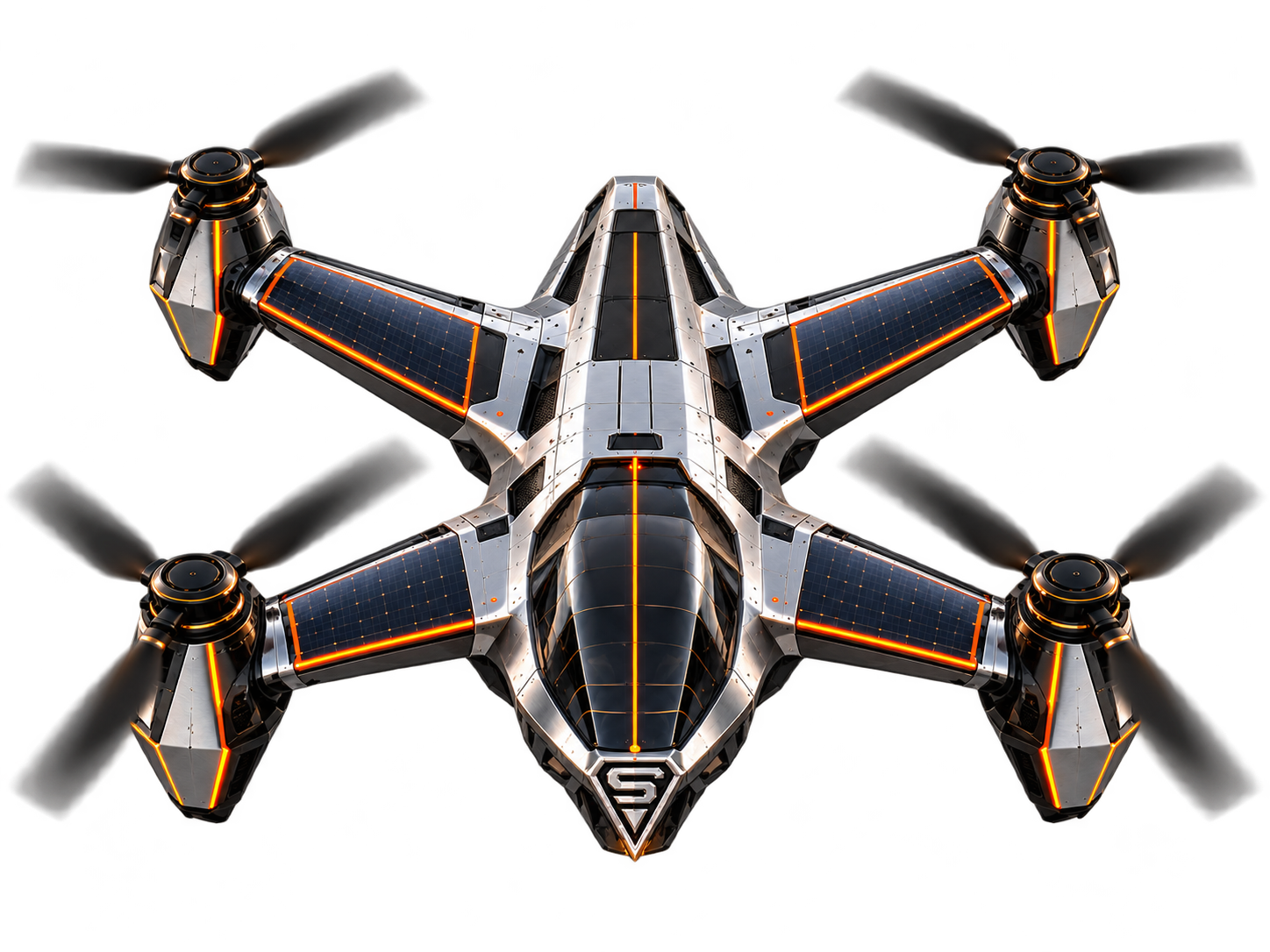
TOP VIEW / PHOTOVOLTAIC WING LAYOUT
A new role in the mission team
Energy support in the air.
The SD4 Specialist Utility Drone (SUD) introduces an airborne replenishment role to
the SkySharks family. It is designed around qualified rendezvous, protected power
transfer and the ability to support a Receiving Mission Drone (RMD) without
automatically interrupting the wider mission.
01REQUEST
Receiving aircraft shares its qualified energy need, position and breadcrumb
history.
02RENDEZVOUS
Mission intelligence assesses the meeting corridor, relative position and operating
state.
03REPLENISH
Protected coupling and energy transfer are supervised with provision for safe
release.
04REQUALIFY
Updated energy reserves inform mission continuation, Home Safe and return planning.
One Mission Fabric / Energy Service
SD4 augments the existing D1-D3 aircraft range with a specialist utility and
replenishment capability. Mission intelligence, SDBB, QIOS interfaces and
PowerFabric contribute to the service architecture.
Asset inspection and calibrated observation records.
D-KIT02
Survey
Multispectral camera kit
Camera mount and harness
Position/time interface
Data workflow and calibration
Vegetation monitoring and georeferenced survey outputs.
D-KIT03
Search and rescue
EO/thermal observation
Observation mount and harness
Georeferencing interface
Responder workflow integration
Authorised responder support. Search and rescue is not radar.
D-KIT04
RF relay
Provisional radio/controller
Mount and power/data harness
RF control interface
Link and transmit-inhibit testing
Permitted-network relay. Band and final antenna fit remain unreleased.
Kits are separate from the core aircraft and service subscriptions. Every host/kit
pairing remains subject to mass, CG, power, thermal, EMC, data-quality and operational
qualification.
12 — Home Safe Qualified Recovery Demonstrator
What survives determines what happens next.
Choose a mission disturbance. Home Safe restores the available protected state,
checks previously prepared breadcrumb and corridor knowledge, then presents a
qualified recovery decision based on surviving capability.
Qualified recovery assessment
A disconnected mission still needs a recovery decision.
Use the pre-authorised recovery plan and onboard state. Return remains conditional
on navigation confidence, flight capability and reserve energy.
Protected powerAvailable
SEB recovery stateStandby
Navigation confidenceQualified
Flight-control availabilityAvailable
Detect the event
Classify the disturbance without treating lost link, degraded navigation and
electromagnetic exposure as the same failure.
Reconstruct surviving capability
Establish trusted power, flight-control, propulsion, navigation and
communications availability.
Requalify breadcrumbs and return paths
Use protected mission checkpoints, current terrain and hazards, energy reserves,
QRC options and relevant operating limits.
Command and evidence the outcome
Issue the bounded recovery request and retain the event, qualification, action
and resulting state.
Use the admitted lost-link corridor while protected power, navigation and flight
control remain available.
Qualification boundary
This demonstrator illustrates decision logic; it is not a live aircraft connection or
released performance result. Recovery requires the relevant control, power, navigation
and propulsion hardware to survive the applicable event. The SEB derives from a
demonstrated pilot power-control platform but has not thereby been EMP-qualified. No
universal EMP immunity or guaranteed return is claimed.
Lost link, GNSS denial and EMP exposure are separate failure cases. General EMP and
positioning-resilience guidance provides a validation framework; it does not certify
SOFOS products.
Established enterprise aircraft provide useful benchmarks. SkySharks™ differentiation
rests on the proposed integration of energy control, specialist mission intelligence and
managed support. Numerical SOFOS performance remains unmeasured.
Mission continuity in the competitive market
Enterprise fleet operation and aircraft relief already exist. DJI Dock 3 describes
automatic dual-drone rotation; Skydio describes dock hives with low-battery
replacement; Percepto provides multi-drone inspection management; American Robotics’
Optimus automates battery and payload exchange.
SOFOS integrates three mission aircraft identities with an additional SD4 utility
aircraft, combining mission context, energy-aware assignment, specialist payloads,
airborne replenishment, SIOS/SOFOS and GMCC support. Performance, compatibility and
operational qualification will determine the advantage. Category leadership and market
exclusivity are not established.
✓* SOFOS programme feature✓ Published feature✕ Documented exclusion— Not confirmed
* SOFOS features are design commitments awaiting configuration-specific qualification.
Select a symbol for its meaning. A dash does not establish that a competitor lacks the
feature.
Mission system feature comparison
Select any feature symbol to see its comparison basis.
SOFOS: pre-production programme. Competitors: manufacturer-described systems; Silent
Falcon EE is a historical 2019 reference. This is a feature comparison, not a verified
performance ranking.
Published specifications and technical context
D-LW01 / long-wing mission platforms
Comparison factor
SOFOS D-LW01
Silent Falcon EE
JOUAV CW-25E
Manufacturer claims use different payloads, weather, reserves and test conditions.
Flight distance is not radio range, and neither establishes permission to operate. No
comparative superiority or category exclusivity is established.
14 — Mission intelligence / From the SOFOS platform
Autonomy with mission purpose.
Persistent mission context, peripheral awareness and controlled compute routing connect
the aircraft to the intended outcome. Intelligence may propose; accepted, scoped authority
governs action.
ENDURANCE
Solar-augmented architecture
Photovoltaic collection and adaptive profiles are development inputs to a measured
energy budget, not an assumed endurance multiplier.
ENERGY
Mission-aware allocation
Platform state, payload demand and reserve needs inform permitted power allocation.
COMPUTE
Qualified compute pathways
The architecture selects local, edge or approved remote resources according to mission
need, link availability and authority.
From intent to evidence.
Formulate
Define the objective, success criteria, limits, participants and available resources.
Qualify
Check evidence, mandatory gates, confidence and resource headroom.
Route
Select an appropriate qualified agent, model, memory and compute pathway.
Engage
Bind participant acceptance to mission-scoped action authority.
Assure
Observe progress, detect drift, apply recovery controls and return evidence.
Manufacturing and lifecycle, connected.
The planned Barcelona integration programme brings structures, propulsion, energy systems,
sensors, communications, versioned mission software and qualification together. Deployment
packages bind capabilities, permissions, provenance and recovery controls to the target
configuration.
INTELLIGENCE
Peripheral Intelligence Vision
Monitor adjacent conditions and weak signals while preserving the primary mission
focus.
AUTHORITY
Human control remains in force
Speed, cost or confidence do not override mandatory gates or required human
intervention.
COMMERCIAL
Products plus lifecycle services
Platform and kit sales can be complemented by SIOS entitlement, mission services,
analytics, training and maintenance within a separately contracted scope.
15 — SOFOS Industries / SkySharks™
Choose the mission. Assemble the team. Keep the objective moving.
SkySharks™ Mission Teams combine four specialist aircraft identities, dedicated SD4
aerial replenishment, protected Home Safe recovery, mission-aware energy management and
SIOS/SOFOS coordination with GMCC support.
Pre-production programme. Aircraft visualisations derive from the approved design
identities. Range, speed, endurance, environmental limits and host/kit performance
require released qualification evidence. Passenger aircraft, eVTOL and satellite
products belong to separate SOFOS Industries programmes.
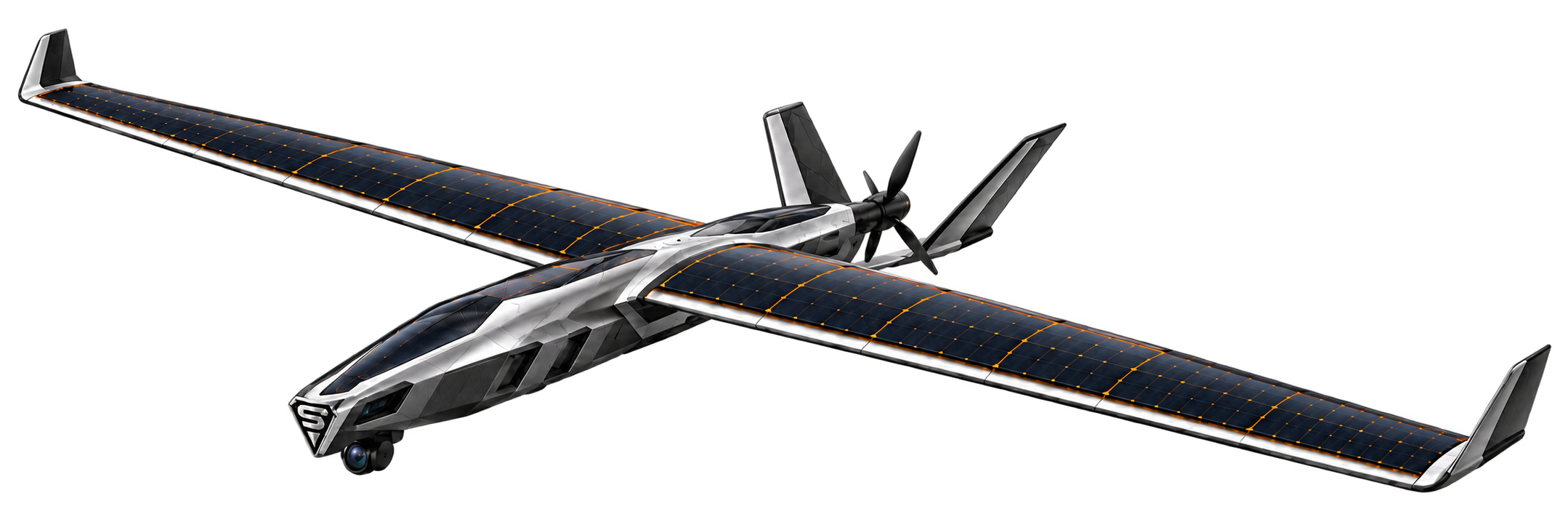
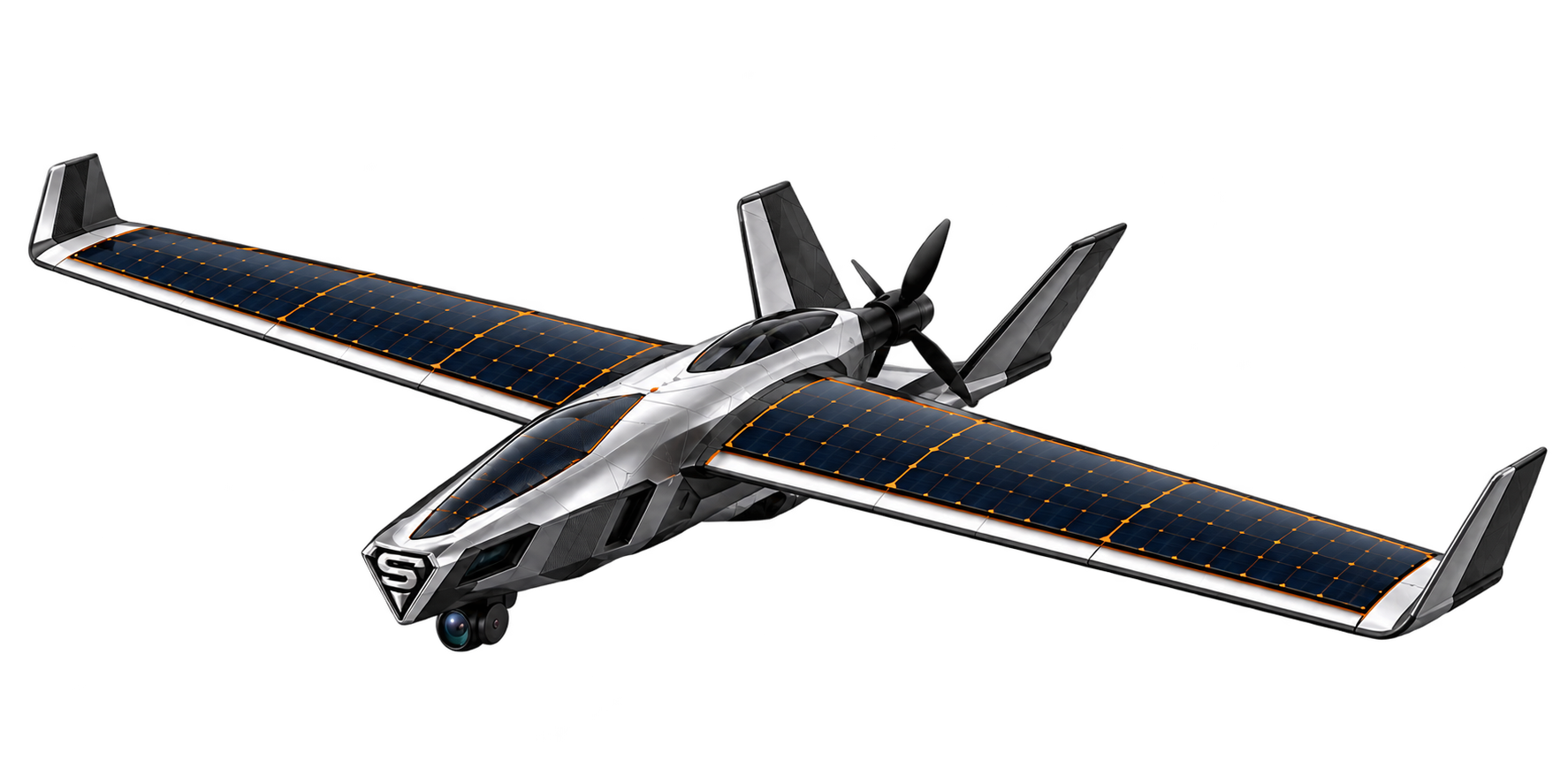 D-LW01 + D-FW01 / MISSION TEAM VISUALISATION